
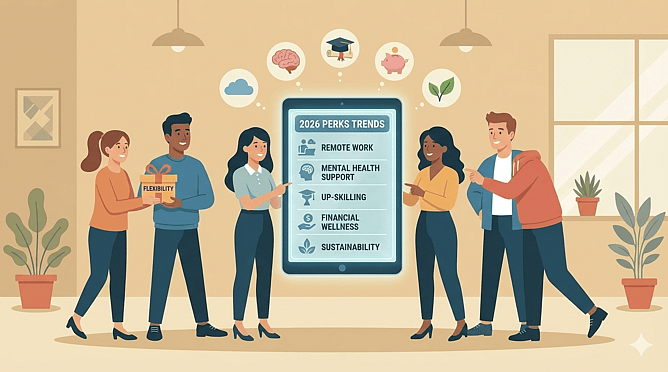
Are your staff perks still relevant in 2026?
Many businesses treat employee benefits programs as 'set and forget'. But as time goes by an untouched program can lose its excitement and relevance, becoming less effective in recognising, rewarding and retaining workers.
The best corporate benefits programs are constantly analysed and optimised. They reflect the needs, wants and wishes of both the company and its workforce at any given moment, keeping pace with changing circumstances, tastes and business priorities.
So what are the key trends in employee perks in 2026?
In this practical, NZ-focused guide, we'll answer the core question that the best HR leaders are asking themselves: do our benefits align with the expectations of the modern employee?
How employee expectations are changing in New Zealand
It began with Covid.
In a matter of days, long-held assumptions about where and how work can be done were upended. Both employers and employees realised that many jobs - particularly those in an office - were far more flexible than they thought.
And so, once the worst of the pandemic passed, much of that flexibility - remote work, choose your own hours - was retained in the form of employee perks.
Worker expectations have continued to change from there. Covid also signalled a shift from nice-to-have, Silicon Valley-style perks - ping pong tables, nap pods, in-office baristas - to benefits that offer more functional and valuable support to staff.
With cost of living pressures ratcheting up in NZ, they're increasingly shaping the perks that workers want. The value of perks that cover some of life's costs - health insurance, a company car, a gym membership, exclusive discounts to major retailers - is rising fast.
In recent years there has also been a growing focus on purpose, work-life balance and holistic health. For most, work isn't seen as the be all and end all, but a means to live a long, comfortable and fulfilling life.
By understanding these changing expectations, NZ businesses position themselves to better attract and retain top talent in a competitive labour market.
The top employee benefits trends shaping 2026
What are the trends that you need to know about in 2026?
1. Flexibility as a baseline, not a perk
Covid showed precisely which jobs are compatible with remote and flexible hours. These policies place more of a focus on work completed than hours logged. They demonstrate deep trust in your workers, which is typically paid back.
In 2026 you should work to establish flexibility as a standard feature of applicable roles, rather than a treat for the lucky few.
2. Wellbeing benefits that go beyond fruit bowls
A healthy worker is a happy and productive worker. By offering proper support to your staff, you can prevent a lot of issues that can lead to extended time off, from sickness to burnout.
In 2026 you should consider developing an employee assistance program (EAP) for in-office support, and providing workers with the tools and assistance they need for a healthy lifestyle: gym memberships, mental health support, nutrition advice, family healthcare services and more.
3. Financial wellbeing enters the mainstream
As the cost of living rises, workers are becoming concerned about how they'll cope. A competitive salary and appropriate bonuses naturally form part of the picture, but knowledge is valuable too.
Consider offering your workers financial training in 2026: how to budget, invest and save for retirement effectively. By offering insights and expertise, you can improve the financial literacy of your staff, and remove some of the pressure they might currently feel.
4. Personalised and choice-based benefits
Every worker is different, and some of the most effective employee perk programs reflect that fact. In the age of the individual, where algorithms personalise our digital consumption to the nth degree, people are beginning to expect similarly customised experiences in the real world too.
In 2026 you could establish personalised perks. There are systems where workers can redeem points or otherwise earn their way to a selection of prizes from which they can choose. Alternatively you can choose or develop specific prizes for specific individuals, which demonstrates intimate knowledge of your team, and shows that you care about them.
5. Career growth and employability benefits
Give an employee a fish, or teach an employee to fish?
In terms of true and total value, the biggest perk you can give your workers is knowledge. By developing career growth-focused benefits, you give your team an opportunity to help themselves.
These benefits can take many forms:
Learning budgets for training with third-party providers.
Mentoring sessions with organisational leaders.
Internal mobility - up or sideways - for those interested in leadership or trying something new.
The best thing about these perks is that the return on your investment can be incredible, because they create a more talented, capable and loyal team.
6. Sustainability and purpose-led benefits
In 2026 attitudes to work have evolved. As mentioned above, most people work to live rather than live to work, but on the flipside, most also want their work to come with a sense of purpose, of doing the right thing, of injecting goodness into the world.
Diversity, equity and inclusion (DEI) schemes are now well established in most major Kiwi organisations. But the best employers go a step beyond, offering benefits like:
Volunteering leave: Allowing employees to commit work hours to causes they care about.
Sustainability-linked incentives: Rewarding teams for reducing waste, emissions or energy use.
Paid community days: Company-organised days that support local charities.
Ethical KiwiSaver contributions: Choosing to contribute to ethical or low-carbon investment options.
A simple framework to review your current benefits and perks
Step 1: Audit what you currently offer
Begin by tallying an inventory of the benefits and perks you offered in 2025. Include formal benefits, informal perks and any regional or role-specific variations. If possible, note eligibility, cost to the business and current uptake.
Step 2: Map benefits to employee and business needs
Assess which benefits support key workforce needs such as flexibility, wellbeing, financial security and career development. Then map each benefit to business priorities like retention, productivity or employer branding, to ensure they're right for your organisation too.
Step 3: Identify gaps, double-ups and low-value perks
Look for overlaps that add complexity while offering limited additional value. Flag low usage benefits or those that deliver unclear outcomes. Work to craft a simple and streamlined scheme - one with minimum uncertainty but maximum impact.
Step 4: Prioritise changes based on impact and cost
Target the quick wins first. Focus on changes that deliver a lot of impact for relatively low cost or effort. Once these are established, move on to the more structural and potentially meaningful changes to your benefits scheme.
When deciding on your perks, ask yourself:
Does this benefit clearly support a real employee need?
Is usage high or low, growing or declining?
Is the cost proportionate to the perceived value?
Does the perk align with 2026 workforce expectations in New Zealand?
Practical employee perk ideas by budget level
What do effective benefits look like in 2026? Here are a few examples, grouped by cost.
Low-cost benefits
These options focus on flexibility and recognition rather than spend:
Flexible start and finish times.
Extra leave options, such as purchased leave or birthday leave.
Simple recognition programs like peer awards or weekly shout-outs.
Mid-range benefits
At this level of spend, employers can introduce wellbeing benefits that offer tangible support to employees:
Wellbeing allowances for fitness, physical therapy or mental health.
Learning budgets for upskilling.
Enhanced parental leave.
KiwiSaver employer contributions.
High-value benefits
Larger organisations may offer significant benefits to their most valuable employees, such as:
Comprehensive health insurance, including specialist cover like mental health support.
Long-term incentive plans tied to performance or tenure.
Paid sabbaticals or extended leave after set milestones.
Financial planning support, including retirement and investment advice.
Conclusion: modernising your work benefits without overcomplicating it
In 2026 staying competitive as an employer isn't about extravagance, it's about relevance - you don't need to spend big, just wisely. You need to understand what your workers value, and meet them where they are.
HR leaders should take a structured, employee-led approach when crafting their benefits scheme. And once the benefits are live, you should review them regularly to ensure they continue to be valuable through 2026 and beyond.
Need help upgrading your benefits program? Say hello to 1Team.
With the help of our custom-branded app, you can offer your team members savings from New Zealand's leading retailers – Torpedo7, Dulux, Pita Pit, Hirepool, Repco, Warehouse Stationery and more – and track exactly how many of your workers are gaining access to and utilising the rewards.
It's a small investment that can drive a big impact. Get started today.